|
Imperial Service College grew from a
small 'cottage' school founded in 1845 by Revd Steven
Hawtrey, curate at Windsor Parish Church and later at
Holy Trinity Church. The school was originally known
as St Marks School.
St Marks soon grew to 50 or so pupils and
the premises at the corner of Goswell Road and Oxford
Road (formerly Clewer Lane and now buried beneath Ward
Royal) were, within 20 years, too small, so new
buildings were built in Alma Road on land obtained
from the Vansittart Estate. These were opened on 25th
April 1862, St Mark's Day, Revd Stephen Hawtrey
remaining as Headmaster. The school was located in
buildings behind what is now The Frogmore Hotel, which
at that time was the Rectory for Trinity Church,
Trinity Place. The school was obviously held in high
esteem as the subscription list, opened to raise money
for the building of the new school, was headed by
Queen Victoria, Prince Albert and the Duchess of Kent.
In 1870 the first boarders were accepted
with additional buildings constructed in Alma Road.
These included a Chapel and Alexander House on the
site now occupied by the Police Station and named
after the Chairman of the School's Governing Body,
Prince Alexander, 1st Earl of Athlone. Across the road
was Lawrence House, on the site now occupied by
Lawrence Court. A short distance northward was The
Hermitage, which still remains today as residential
accommodation, and now known as Camperdown House.
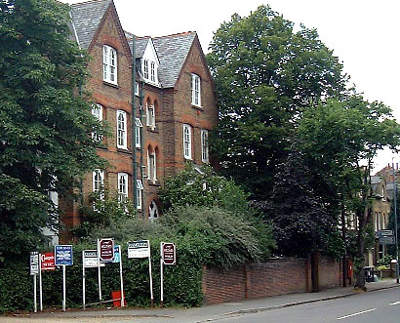 Camperdown
House, formerly The Hermitage, now converted into
privately owned flats
Camperdown
House, formerly The Hermitage, now converted into
privately owned flats
The main entrance to the school was
opposite Lawrence House. There is some question as to
who is commemorated by this building but it seems
likely that it was Sir John Lawrence rather than his
brother, Sir Henry Lawrence.
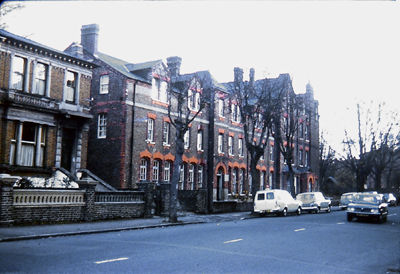
Lawrence House
as viewed from the Kipling Building gateway in
1975
(© J Handcock)
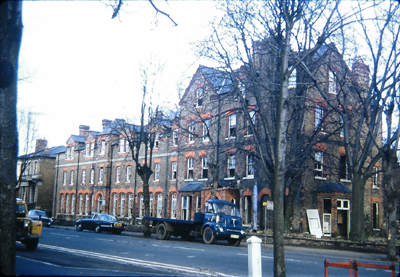
Lawrence
House as viewed from the Goodhart gateway,
opposite St Mark's Road, in 1975
(© J Handcock)
In addition there was Roberts House
(68 Alma Road), since demolished, and Connaught House,
now known as Upton House School in St Leonard's Road.
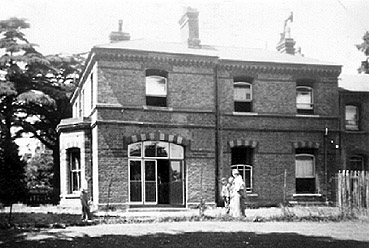 Connaught
House, now Upton House School in St Leonards Road
Connaught
House, now Upton House School in St Leonards Road
St Marks Middle School occupied new
buildings in Grove Road where a plaque on the Parish
Rooms, dated 1871, remains to this day.
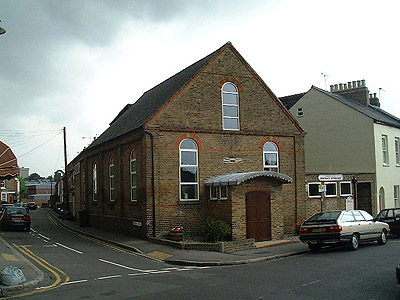 The former
St Marks Middle School, now the Parish Rooms
The former
St Marks Middle School, now the Parish Rooms
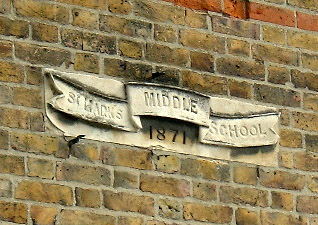 The plaque
above the entrance of the former St Marks Middle
School
The plaque
above the entrance of the former St Marks Middle
School
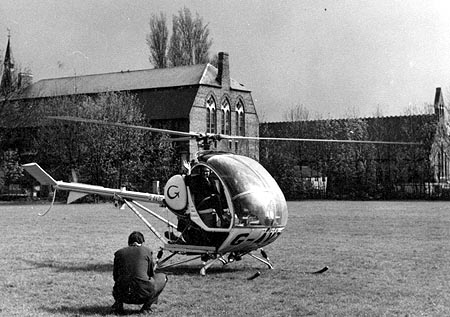 Kipling Lawn in
1969 with the St Marks School Room, to the left, and
the 1870 Chapel, right.
Kipling Lawn in
1969 with the St Marks School Room, to the left, and
the 1870 Chapel, right.
The helicopter is about to take off for a photo
survey of Windsor
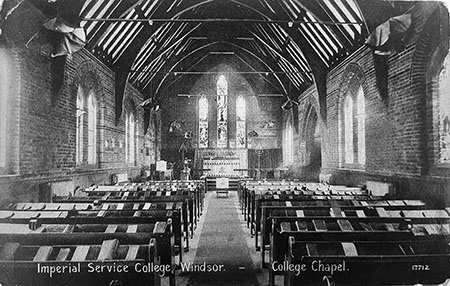
The
interior of the Chapel
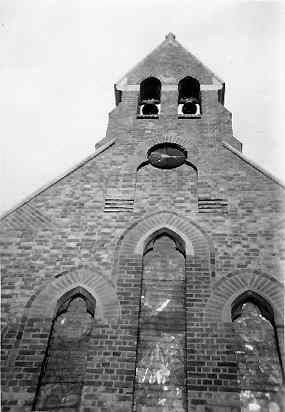 A close up
of the Chapel Belfry taken by a pupil in 1936
A close up
of the Chapel Belfry taken by a pupil in 1936
In 2005 we were given the following
pictures by David Andrews and to whom we are very
grateful. It has not been possible to positively
identify all the buildings featured in the photographs
and so any assistance would be appreciated.
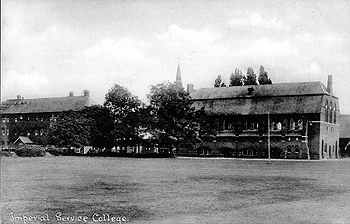 A view to
the south showing the School Room with The Lodge
to the left
A view to
the south showing the School Room with The Lodge
to the left
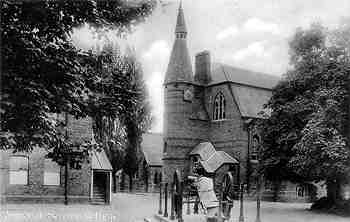
The
School Room with Roberts cannon outside.
It is believed that the Gym was to the left,
or in the School Room itself
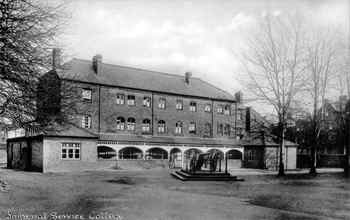
Alexander
House with the Roberts cannon in foreground
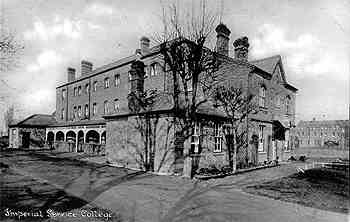
Alexander
House from the Alma Road entrance, with
The Hermitage (Camperdown House) in the
background, to the right.
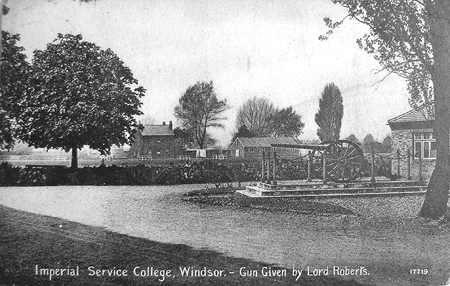
A view from a
similar angle but looking more to the west, with
Alexander House now out of shot to the right. In
the distance, centre left, is Cromwell Cottage
with Vansittart Road and Vansittart Recreation
Ground beyond. Here the gift of the cannon by Lord Roberts is
acknowledged.
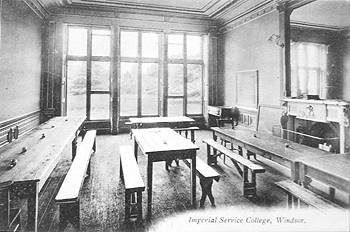 A classroom at
Imperial Service College in Edwardian times. The
bench seats (forms), large mantlepiece and
overmantle mirror, plus extensive plasterwork
and cornices show that this classroom was one of
those believed to be set up in a converted
private house adjacent to the school.
A classroom at
Imperial Service College in Edwardian times. The
bench seats (forms), large mantlepiece and
overmantle mirror, plus extensive plasterwork
and cornices show that this classroom was one of
those believed to be set up in a converted
private house adjacent to the school.
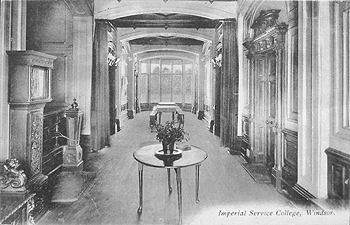 A
hallway quite possible in the same house as
the classroom above.
A
hallway quite possible in the same house as
the classroom above.
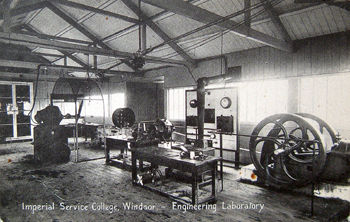 The
Engineering Laboratory
The
Engineering Laboratory
St Mark's
School and USC
At the start of the 1900s, the St.
Mark's School amalgamated with the United Services
College, which had originally been founded in 1874 at
Westward Ho!, Bideford Bay, Devon, originally
occupying a row of former lodging houses there. The
first headmaster was Mr Cormell Price who, after
Oxford and a spell as a tutor in Russia, came to
Haileybury School in Hertford to organise the 'Modern
Side'. Haileybury was to play a significant part in
the later history of the school at Windsor during the
Second World War.
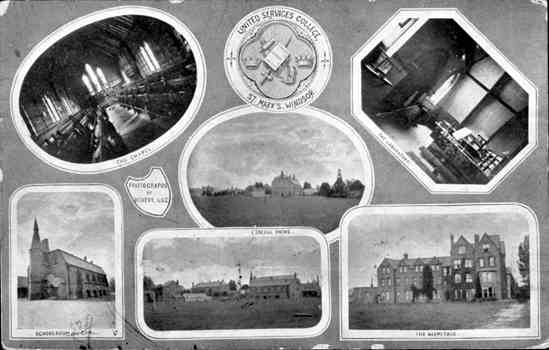
After the merger, the
school became known as United Services College, St.
Mark's, Windsor. The following photograph is an
enlarged image from the postcard featured at the start
of this article.
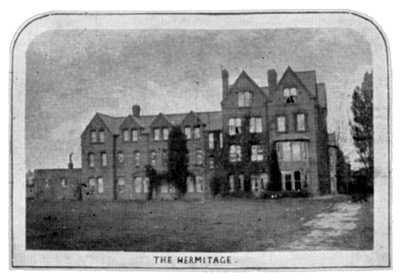
The
Hermitage in 1906 taken from the USC postcard.
This building remains to this day and is known as
Camperdown House although this view is now
obscured by two very large Horse Chestnut trees
growing side by side! The building has been
converted to flats, with an extension in a similar
style to the left of this view.
Unfortunately, USC had encountered
financial difficulties in 1903 and failed. The boys
from USC, following moves through two other schools,
arrived at Windsor in 1906. It is this connection that
links Windsor with Rudyard Kipling, who had been a
pupil at USC from January 1878, when he was 12, and
remained there until he returned to India in September
1882, taking up a post on the Civil and Military
Gazette in Lahore. His stories about the USC, 'the
Coll.' as he often called it, are featured in 'Stalky
and Co'.
USC
becomes ISC
The school in Windsor soon
encountered financial difficulties too and so in 1911
approaches were made to the Imperial Service College
Trust, whose objective was to assist with the
education of army officers' children. The result was a
new lease of life as the Imperial Service College.
With the death of Revd Nagel, the
headmaster, also in 1911, Mr EGA Beckwith was
appointed his successor in April 1912.
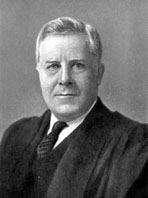 E G A
Beckwith, MA Oxon.
E G A
Beckwith, MA Oxon.
Headmaster 1912-1935
In due course parents expressed a
need for a new Junior School and so in 1920 ISC bought
the estate of Mr Edmund Baines Foster which included
Clewer Manor and which was used for the ISC Junior
School from 1922.
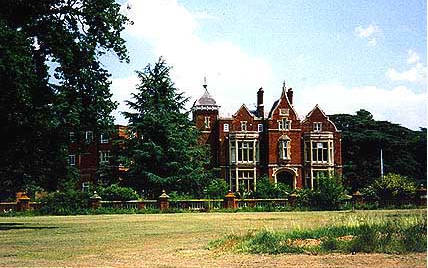
Clewer Manor used
by Haileybury Junior School until its move in 1997.
It was purchased by ISC in 1920 and used as the
Junior School from 1922. In 2002 the Manor was
converted to flats, and houses were built in the
grounds.
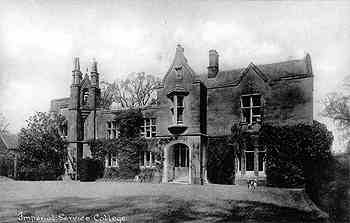
One of a
series of ISC postcards believed to show Clewer
Lodge when used by ISC's headmaster,
Mr Beckwith.
Other buildings were acquired as
part of the estate, including Clewer Lodge, in which
Mr Beckwith lived, and the gatehouse to Clewer Lodge.
Although the lodge was demolished to make way for Peel
Close, the gatehouse remains at 364, St Leonard's
Road.
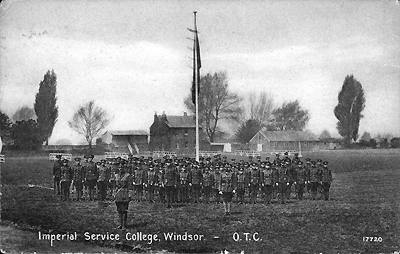 Imperial Service
College, Windsor - OTC (Officer Training Corps)
Imperial Service
College, Windsor - OTC (Officer Training Corps)
The postcard view above was posted
in 1925, although the image could be several years
earlier. Being a school with a military background,
the training corps were important in the school's
daily activities. Here the Officer Training Corps are
photographed on parade.
The view is taken across the area that was
to become Kipling Building lawns, looking north-west
with Vansittart Road, running left to right, beyond.
The Officer Training Corps are on parade beneath a
flag staff that features several cross arms presumably
for raising signals. To the left, and running parallel
with the lane (Vansittart Road) beyond is a rifle
range, then comes a pavilion with steps that was later
used by a local shooting club in the 1950s, then
Cromwell Cottage and another single storey building to
the right of that. We believe that this last building
was demolished when Kipling Building was erected in
1939. Behind the pavilion and Cromwell Cottage,
several of the trees remain to this day (2003) in
Vansittart Road Recreation Ground, though the two
poplar trees are now gone, lost during storms in
recent years.
In various articles and reports that we
have read while researching the history of ISC, the
college is always referred to as 'Coll.' and 'Big
Side' is believed to be the northern area of the ISC
grounds, before the construction of Kipling Building,
the area now occupied by an office block dating from
the 1980s.
Buildings
and Benefactors
Financial difficulties remained
throughout the early 1900s because the Imperial
Service College Trust allowed only for bursaries,
leaving other debts outstanding. Benefactors continued
to come forward, including Patrick Alexander, aviation
pioneer, friend of the Wright brothers, and financial
supporter of many aeronautical projects. Patrick
Alexander will be featured in future ThamesWeb
articles. He was closely connected with the school
until his death on 7th July 1943. He lived at 28, St
Mark's Road, Windsor, from 1940-1943. His grave is in
Windsor Cemetery and is illustrated in an article here.
In 1922 another benefactor, Mr F E
McCormick-Goodhart, donated land that was sold to
benefit the school, part of which was developed as
College Crescent. On 23rd September 1924 Mr
McCormick-Goodhart died and so the College lost one of
its greatest supporters. The Headmaster, Mr Beckwith,
later wrote in his history of ISC, Imperial Service College,
1912-1933, the following
tribute to Mr McCormick-Goodhart:
F. E. McCORMICK-GOODHART, Esq.
By the death of
Mr. McCormick-Goodhart on the 23rd of September,
1924, the College loses one of its greatest
benefactors. At a time when the finances of the
College were at their lowest and it seemed
impossible that they could recover, Mr. Goodhart
came to the rescue. Not only did he remove a
terrible technical embargo of over £70,000 by the
payment of a large cheque, but also in addition gave
a further cheque of £9,000 to meet current debts,
and then, as if such generosity was not enough,
bought the Alma Park Estate for £13,000, the free
use of which the College has since enjoyed. Although
he found it necessary to leave England in order to
acquire the status of an American citizen, he
continued to take the liveliest interest in the
College, and had actually arranged in his last
letter to the Headmaster to stay with him in the
summer of this year, when he purposed coming over to
England. It is no mere 'facon-de-parler' to say that
the College owes very much of its present
flourishing condition to him.
Truly may it be said of Mr. Goodhart -
"his works do follow him." In addition to being a
Governor of the College, Mr. Goodhart was a leading
member of the Council of the Church Army.
Mr McCormick-Goodhart had decided to
leave England at some point and take up American
citizenship, yet he continued to take the liveliest
interest in the College, planning a visit to Windsor
and to stay with Mr Beckwith in the summer of 1924.
The Goodhart Gates were erected at the
main entrance in Alma Road in his memory. HRH The
Duke of Connaught and Strathearn laid the foundation
stone for these gates on July 24th 1926. They were
located almost exactly opposite the junction of Alma
Road with St Mark's Road. A wall in the same style,
together with a second set of gates, extended beyond
Camperdown House. The fine St Mark's lions on the
pillars of the Goodhart Gates were reproduced from
figures of the same in Ripon Cathedral and were
incorporated at the suggestion of old boy, Barrington
Hudson.
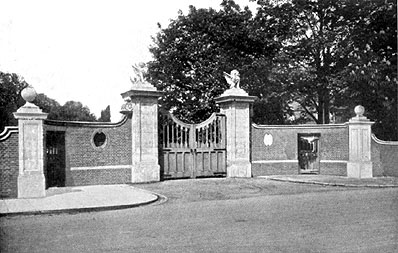 The Goodhart
Gates in Alma Road
The Goodhart
Gates in Alma Road
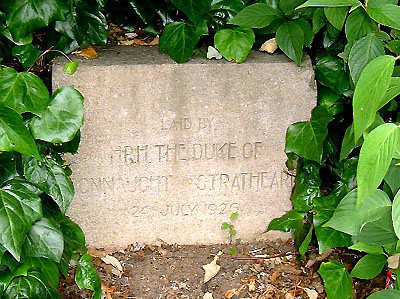 The Foundation
Stone of the Goodhart Gates. (Photo July 2000)
The Foundation
Stone of the Goodhart Gates. (Photo July 2000)
Located at the front and to the left of the current
Police Station.
Laid by HRH The Duke of Connaught and
Strathearn, July 24th 1926.
In 2002 the only remaining part of
the wall and gate in the original style is to the
northern end, alongside Camperdown House, the curved
entrance now obscured by ivy. Related
article - The demolition of the ISC buildings,
Windsor
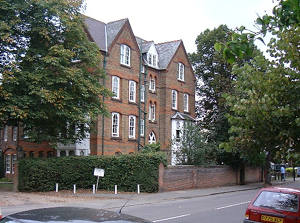
Camperdown
House
The single gate, to the right and
beneath the tree in the above picture, is stoutly
constructed of oak although it is beginning to show
signs of age. [Update 30th September 2002. The frame
has been strengthened and the gate painted with a
black preservative paint. Update April 2005 Camperdown
House received substantial attention to the slate
roof.]
The bricks used in the construction of the wall
are of non-standard size, and we have been advised
that they are known as Dutch bricks. There are several
examples of houses nearby also constructed in the same
style of brick in Vansittart Road, adjacent to the
recreation ground, and at the southern end of Alma
Road, either side of the junction with Goslar Way.
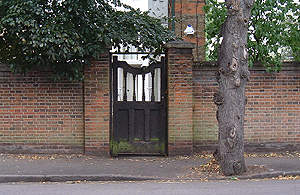
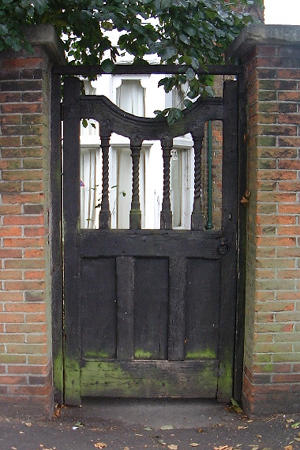 The
remaining gate in the same style as The Goodhart
Gates of 1926.
The
remaining gate in the same style as The Goodhart
Gates of 1926.
Another valuable benefactor was Mr F
C Macaskie who donated generously to the college,
funding a classroom block which was named after him,
in the area now crossed by Goslar Way. Mr Macaskie
J.P. died on 17th January 1933. Mr Beckwith wrote the
following obituary.
F. C. MACASKIE, Esq., J.P.
It is with the
deepest regret that we record the death, following
an operation, of Mr. F. C. Macaskie, J.P., on the
17th January, 1933. To many, his is but a name
connected with classrooms, but to a few of us here,
and to the writer especially, the great privilege
was vouchsafed of knowing the man, and it is a
further privilege to be able to let the present
I.S.C. generation know in the hope, too, that future
generations may also know what Mr. Macaskie did for
the I.S.C. and how it is that he has earned the name
of one of the School's greatest benefactors. Not
only did he pay for the Macaskie classrooms, but
also gave the writer another five figure cheque to
wipe out a heavy load of back debts, and it was the
writing of this cheque that made it possible for the
Trustees of the King Edward's Horse Fund to make
over the Fund to the School, in very truth a case of
" bis dat qui cito dat." Hence the name of Macaskie
must be inextricably bound up with any success that
the School has achieved. Such generosity speaks for
itself, but those who were present when he laid the
foundation stone of the Macaskie classrooms will
never forget that wonderfully human touch, when he
handed over a further cheque for fifty pounds to
celebrate the event, "so that (to quote the gist of
his humorous remarks at the time) those who were not
especially interested in work and to whom the
classrooms rather denoted an interference with the
liberty of the individual might derive at any rate
some enjoyment, and, he hoped, might not feel too
evil effects".
Surely it is no spirit of exaggeration
or adulation that we may say that the I.S.C. boys of
the future will rise up and call him blessed, while
those of yesterday (with memory of the huts) have
already experienced a deep and abiding sense of
gratitude.
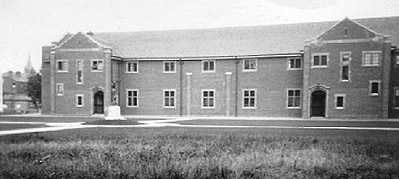 The Macaskie
Classroom Block looking to the east.
The Macaskie
Classroom Block looking to the east.
Note Trinity Church far left background
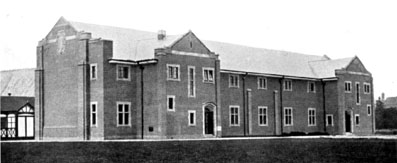
A second
view of the Macaskie classroom block looking
south-east.
After WWII the building was used as a barracks
and were finally demolished in 1966 to make
way for Goslar Way. King Edward Horse Hall was
to the right of this view and York Road
beyond, to the south.
The
Boathouse
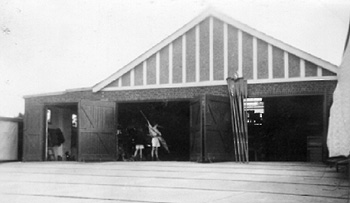 The
Boathouse pictured in 1937
The
Boathouse pictured in 1937
Being just a short distance from the
River Thames, rowing was an important sport at the
Imperial Service College and eventually, in 1934, the
College had their own boathouse. Prior to that the
boys had used the facilities belonging to Eton College
and their boathouses near Windsor Bridge. The new
boathouse was opened on May 22nd 1934 by Lady Mary
Crichton. Afterwards the dignitaries, Eton College
boating masters and their wives were entertained to
tea in the grounds of the Eton Country Club, later
demolished to make way for the original Windsor War
Memorial Swimming Baths in 1962.
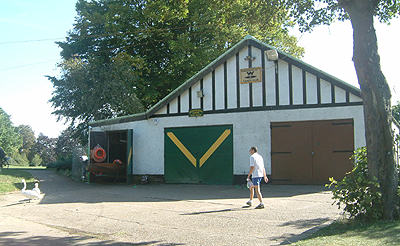 The
boathouse in September 2006, near the Windsor
Leisure Centre.
The
boathouse in September 2006, near the Windsor
Leisure Centre.
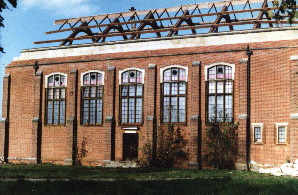
The King
Edward Horse Hall
In the late 1920s ISC was approached
by King Edward VII's Horse Regiment Endowment Fund.
With the disbandment of the regiment, the fund's
trustees wished to pass on the assets to an
educational institution that would permit bursaries to
be paid for sons and descendants of commissioned
officers. Part of the fund was to be used to create a
memorial to the regiment, and this resulted in The
King Edward Horse Hall being built in 1931 and used as
the School Hall.
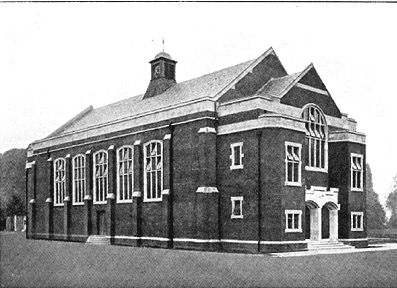 The King
Edward Horse Hall opened in 25th July 1931...
The King
Edward Horse Hall opened in 25th July 1931...
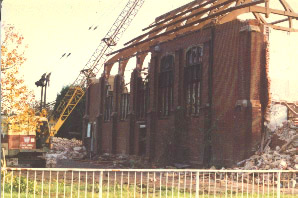 ...but was
demolished less than 40 years later.
...but was
demolished less than 40 years later.
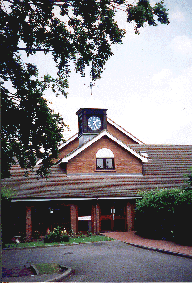 King
Edward VII Horse Hall Clock Tower, somewhat lower
King
Edward VII Horse Hall Clock Tower, somewhat lower
than when originally installed on the roof of the
old hall
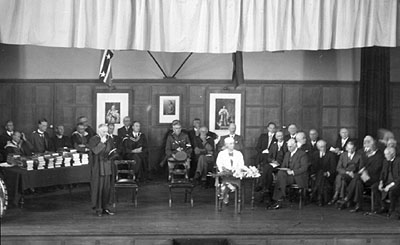 Prize Giving Day 1937
The panelled stage of King Edward's Horse Hall
The
Beckwith Memorial
With the death of Mr
Beckwith in 1935, a memorial to him was commissioned,
'The Statue of Ambition', which stood in the
grounds near the Horse Hall. The Old Boys Journal
(March 1937) reports that
‘The design is simple but dignified and adds
greatly to the effect of the hall and the
classrooms which flank the court on the south and
east sides. In the centre of a grass quadrangle,
at the intersection of two flagged paths, there is
a bronze figure of 'Ambition', the work of the
late Richard Goulden. The statue is supported on a
granite pedestal and was the gift of Mrs Goulden.
The north side at present remains unfinished.’
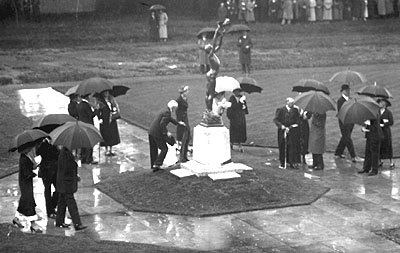 The Statue of Ambition is unveiled,
July 1936, by the Duke of Connaught
The Statue of Ambition is unveiled,
July 1936, by the Duke of Connaught
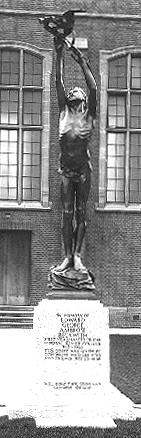 The Statue of Ambition in Beckwith Court
with the King Edward Horse Hall behind
The inscription reads "In Memory of
Edward George Ambrose Beckwith, First Headmaster of
The Imperial Service College, 1912-1935, This Court
was given by Governors, Masters, Boys and Friends,
July 25th 1936." Below it reads "Well done
thy good and faithful servant." At the bottom of the picture, by the
path, a small plaque commemorates the unveiling of the
statue by HRH
the Duke of Connaught and Strathearn, President of the
Board of Governors. On the day of the
unveiling, the weather was most unkind, with heavy
rain. Mr Clyde Young was
the architect of the memorial having designed the King
Edward Horse Hall and classrooms buildings. 'The Statue of Ambition' is now believed
to be in the possession of Haileybury
School Hertford.
'Tokio' -
The Chaplain's House
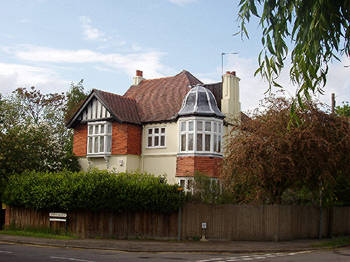 'Tokio' 38
York Road
'Tokio' 38
York Road
In February 1920 a reference to the
house 'Tokio' (38 York Road) was found in an ISC
journal 'Chronicle' which reads ‘The house 'Tokio' in
York Road, which is now the property of the College
and is to be known in future as the Chaplain's House,
is under Mr Healey's charge.’
This house was the subject of a planning application
for demolition in 2003 which was fortunately refused.
Details
Kipling
Memorial Building
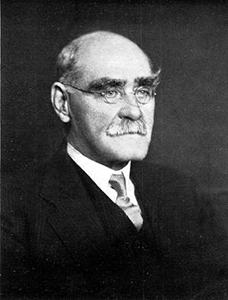
Rudyard
Kipling was born in Bombay on December 30,
1865
and died on January 18, 1936 in London
On the death of Rudyard Kipling, a
past pupil of the USC at Westward Ho! from 1878 to
1882, it seemed appropriate
that ISC should benefit from the Memorial Fund set up
in his honour. Six months later a letter from the
Governors of ISC appeared in The Times as follows:
Sir,
Rudyard Kipling was at the United Services College,
Westward Ho! from 1878 to 1882. His old school is
now at Windsor under the new name of the Imperial
Service College, and it aims at educating, on
favourable terms, the sons of those who have served
throughout the Empire in any capacity under the
Crown. We feel that this aim is in keeping with the
ideals implicit in his writings. In a letter written
not long before his death he expressed his great
pleasure that the continuity and traditions of his
old school were being so well maintained and
fostered by the College.
We wish therefore to appeal for funds to
perpetuate his memory by erecting a library or group
of buildings containing a library at the Imperial
Service College, to be called after him.
Subscriptions should be sent to the Hon. Secretary,
Kipling Memorial Fund, imperial Service College,
Windsor.
We are, etc. etc.
Athlone
(Chairman, Board of Governors ISC)
Stanley Baldwin
Alexander J Godley General (OUSC and Member of
Board of Governors ISC)
Hepworth A Hill, Lt. Col. (President, OUSC
Society)
L C Dunsterville, Major-General (OUSC and
President of the Kipling Society)
Rudyard
Kipling Memorial Fund Banquet
In March 1938, in the ISC Journal,
the following report was published about the
fundraising banquet.
An inaugural
Banquet was held at Grosvenor House, Park Lane, on
the 17th November, 1937. The Chair was taken by the
President of the Fund, Major-General the Earl of
Athlone, K.G., who was accompanied by Princess
Alice, Countess of Athlone. The guests of honour
were "Stalky" (Major-General L. C. Dunsterville) and
"M'Turk " (Mr. G. C. Beresford). There were over
nine hundred guests present, among them being the
Brazilian Ambassador, Lord Londonderry, Lord and
Lady Dufferin, Lord and Lady Plymouth, Lord and Lady
Greenwood, Lord and Lady Nuffield, Mr. Winston
Churchill, General Sir Alexander and Lady Godley,
Sir Bruce Bruce-Porter, the Headmaster and Mrs.
Tollemache, Members of the Coll. Staff,
Representatives of the Services, the Royal Empire
Society, the Kipling Society, and the President and
Hon. Treasurer representing the I.S.C. Old Boys'
Society.
Lord Athlone read
the following message from the King: "I am glad to
know that representatives of all parts of the Empire
are united in planning a fitting memorial to Rudyard
Kipling, whose genius is the common heritage of all
who speak the English tongue."
Messages were also
received from Lord Linlithgow, President of the
Indian Committee of the Fund; Lord Tweedsmuir,
President of the Canadian Committee; Lord Gowrie,
President of the Australian Committee; Sir Patrick
Duncan, President of the South African Committee;
Lord Galway, President of the New Zealand Committee;
and letters from Dr. Nicholas Murray Butler,
Chairman of the American Committee; and from Mrs.
Kipling.
The loyal toasts
were proposed by Lord Athlone and a silent toast was
drunk to Kipling's memory.
Mr. Winston
Churchill proposed the toast of the Fund in a speech
of great eloquence. He paid tribute to Kipling as a
poet of Empire whose memory should be worthily
perpetuated in the carrying to fruition of the
objects for which the Fund was founded. There was
never a moment when he did not feel the surge of his
(Kipling's) appeal upon " the great verities of our
race and State," and he maintained that Kipling had
succeeded better than any Blue Book in laying before
those who dwelt at home, true pictures of British
administration in India. Nor had he rested there,
for life in each one of the Dominions had been
adorned and interpreted by strokes of his wand.
Nothing would ever deprive him of the gratitude
which Britons owed him for his inspiration, or of
the homage which English-speaking peoples would
render to his genius.
Lord Athlone, in
replying to the toast, said that as a result of the
Dinner nearly £10,000 had been added to the Fund,
which now stood at £45,000. 'The Council was aiming
at £250,000 and would continue its work until it had
secured that sum. The money would be devoted to the
erection of suitable memorials to Kipling at
Westward Ho! and, possibly, at Windsor, the building
of a Kipling Library in the grounds of the I.S.C.
and the endowment of Bursaries tenable at the I.S.C.
for the sons of those engaged in the service of the
Empire.
Lord Greenwood
proposed the toast of the Guests. In the course of
their replies, "Stalky" and "M'Turk" dispelled some
popular illusions as to the activities of the trio
at Westward Ho!, but at the same time supplied
further details of them and of Kipling's life at
school.
Lord Plymouth
proposed the toast of the Chairman and paid a
well-deserved tribute to the work he was doing to
promote the success of the Fund.
The string band of
H.M. Irish Guards played during dinner and
afterwards Mr. Peter Dawson sang "The Irish Guards "
and "The Smugglers' Song" and Mr. Hugh E. Wright
spoke "Sestina of the Tramp Royal."
Coll. Prefects
acted as stewards in collecting subscriptions that
were afterwards made by the guests in response to
the appeal.
* * *
The present position is that next
September six Kipling scholars will
join the I.S.C.; one from each of the Dominions,
one from India and one from the Empire generally
(including England and British communities in
foreign countries).
In 1937 The Journal of the ISC Old
Boys reported that the plan was still for the Kipling
Memorial Library and Laboratory block to be built to
the west of the Beckwith Memorial Court but finally a
new classroom block was decided upon to the north, the
foundation stone for which was laid in March 1939.
1939 and
the School Prepares for War
The following
article was published in the Old Boys Journal of April
1939
The College has
been organised as a unit in the A.R.P. Scheme at
Windsor, and A.R.P. and the Crisis have left their
marks. On the 2nd July last, A.R.P. Drill was
heralded by the bell sounding the alarm at 9.45p.m.
Immediately all lights were extinguished and
everyone assembled in their respective shelters.
Several boys from each House had previously been
detailed to act as dispatch-riders and stretcher
bearers, and on the alarm being sounded, they went
straight to Headquarters in Alexander House Junior
Common Room.
The scheme was
that Cambridge House had been hit by incendiary
bombs, and a fire-fighting squad rushed to deal with
the blaze. This was made extremely realistic by some
ingenious smoke bombs manufactured by Mr. Spauls.
Another incendiary bomb was reported on the top of
Lawrence House, which Major Nicholls gallantly
extinguished with a bucket of sand. A high explosive
bomb was dropped on Camperdown House, and the
stretcher-bearers had a busy time carrying the
wounded up to the First-Aid Station in Roberts
House, where Mrs. Holdway was in charge. A rescue
party composed of the College groundsmen also went
over to Camperdown House and assisted with the
wounded.
Sir Archibald
Campbell (the Head A.R.P. Organiser for Berkshire)
and Colonel Robinson from the Home Office,
accompanied by the Mayor of Windsor, watched the
proceedings and were shown round the various Houses,
where they saw the boys assembled, theoretically, in
their gas-proof shelters.
The cease fire
signal was sounded at 10.30, whereupon everyone
returned to their beds. It was an extremely
instructive demonstration, but let us hope it will
never have to be put into practice.
During the Crisis
gas-masks were fitted, windows were painted over and
trenches were dug by the boys. The present condition
of the trenches is uncertain, but it hoped that they
are not in such a state as will be an inducement to
aquatic sports during the warmer weather.
In the same edition, April 1939, the
following editorial was published giving details of
the progress of the Memorial plans.
The outlook at
home, or at any rate at the Coll., is less fraught
with anxiety than the outlook in world affairs. The
Kipling Memorial Fund Council has decided to place
at the disposal of the School the sum of £32,000 for
the erection of two new houses. They will be built
on Big Side facing South, slightly in rear of the
line of Alexander House. It is intended that they
should form the central portion of a block of six
houses extending from Alma Road to Vansittart Road,
to be known probably, as the Rudyard Kipling
Memorial Block. The two houses to be built now will
contain from 47 to 50 boys each, with Housemasters'
quarters at either end and Matrons' quarters in the
centre. They will be occupied by the boys at present
living in Roberts, Connaught, Beckwith and Kitchener
Houses. An account of the laying of the foundation
stone by Princess Alice appears on another page, and
it is expected that the houses will be ready for
occupation by November, 1939.
In front of the new block on Big Side,
grass cricket nets have been laid on the West and
hard cricket nets on the East. A new cricket square
has been constructed in the middle of the Rec., and
it is hoped that this will soon be accompanied by an
adequate pavilion.
The thanks of all concerned with the
welfare of the Coll. are due to the Memorial Fund
Council for enabling this project to be carried out,
for, although many of us will regret the passing of
Big Side and its surroundings as we knew it, the
question of housing was a burning problem that had
to be solved before the Coll. could expand much
more. Those boys who have lived in scattered houses
ill-adapted for the purpose will now be housed
within the School grounds nearer their fellows, in
first-class quarters equipped (as the house-agents
say) with every modern convenience. The temporary
shelving of the plans for a Library and the
completion of the Quadrangle is more than
compensated for by this achievement.
Also in April 1939 a report was
published of the Foundation Stone ceremony.
Rudyard
Kipling Memorial Building
The foundation
stone was laid on Monday, March 6th, 1939, by H.R.H.
Princess Alice, Countess of Athlone, who on her
arrival, inspected the Guard of Honour of the O.T.C.
The Earl of
Athlone welcomed the guests, among whom were the
High Commissioner for India (Sir Firoz Khan Noon),
the Provost of Eton, the Rector of Beaumont College,
the Lord Lieutenant of Essex, Colonel Lionel James,
the Governors of the College and a large number of
parents, Old Boys and friends, and mentioned that
Lord Kenilworth had taken a prominent part in the
inauguration of the Rudyard Kipling Memorial Fund.
The Hon. Vincent
Massey, P.C, High Commissioner for the Dominion of
Canada, said that it was proper that the name of
Kipling should be commemorated by this building in
the grounds of the school which he had immortalized.
The School, in a different place and under a changed
name, was faithful to the traditions in which
Kipling so firmly believed. He welcomed the idea
that boys from the Colonies should be educated at
the Imperial Service College and hoped that some of
those who passed through would make their way to
Canada and help in the development of the Dominion.
The Headmaster
expressed the thanks of the College to all who had
helped to make possible the erection of the new
building and particularly the Kipling Society. He
also announced that Princess Alice had graciously
consented to become Patron of the College.
Her Royal Highness
then formally laid the Foundation Stone and stated
that she had had a very charming letter from Mrs.
Kipling, saying what great pleasure this memorial
would have given to Kipling.
Three hearty
cheers were accorded to her, after which the guests
were entertained to tea in the K.E.H. Hall.
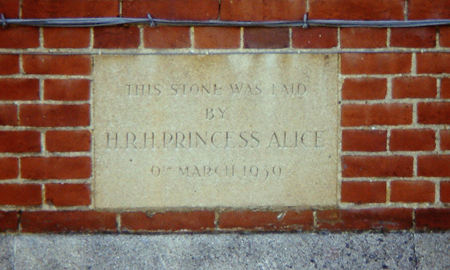 The simple
Foundation Stone photographed in the 1970s
The simple
Foundation Stone photographed in the 1970s
A similar report appears in the
Kipling Journal, No 49 of April 1939 which reads:
In the Daily Telegraph and Morning
Post (March 7th) there appeared a long account of
the Laying of the Foundation Stone of the Rudyard
Kipling Memorial Buildings at the Imperial Service
College, Windsor, on the previous day, 6th March
1939, by Princess Alice, Countess of Athlone. The
college is a direct descendant of the Old United
Services College at Westward Ho!, the scene of the
immortal 'Stalky and Co.' The Earl of Athlone told
those present that the new buildings would allow
more than 100 boys now living in houses outside to
be accommodated within the college. The Memorial
Fund now totalled £40,000 and five Kipling
scholars had already arrived. The Hon. Vincent
Massey, High Commissioner for Canada, said there
could not be a more suitable site for a memorial
to Kipling than the school which he immortalised.
In a different place and under a changed name it
was faithful to the traditions in which the author
so firmly believed. It was fitting that several of
Kipling's former school-fellows were present, and
they would agree that Kipling would have been very
happy to have his name permanently linked with the
school he loved. Mr. L de O. Tollemache, the
headmaster, said that it was largely due to the
Earl of Athlone that the fund had been so
successful. Princess Alice has been a devoted
friend to the school, and he was glad to say that
she had become patron of the college.
Kipling
Memorial Building Completed
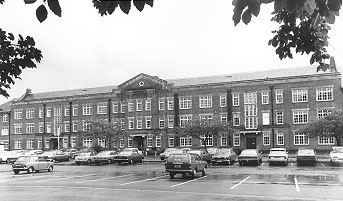 Kipling
Building (dating from 1939) viewed from the north
in the 1970s
Kipling
Building (dating from 1939) viewed from the north
in the 1970s
With the onset of the war, and the
original school buildings, Connaught House and Roberts
House, already commandeered by the army, The Rudyard
Kipling Memorial Building (locally known as Kipling
Building) was completed by September 29th 1939,
delaying only for a week or two the start of the
Christmas Term. The building comprised two school
houses, retaining the names of Connaught and Roberts,
and each accommodating fifty pupils. At the eastern
and western ends of the building were house masters'
accommodation. The building was designed by Mr Clyde
Young in collaboration with Mr. Bernard Engel. On the
south side was a lead plaque illustrating the
characters of the 'Jungle Book' modelled by Mr Benno
Elkan. This plaque is now installed in the building
currently occupying this site in Alma Road, Windsor.
The writer recalls Kipling Building from
the 1950s. It was very solidly built with large stout
wooden doors, varnished, with high quality, polished
wood floors throughout. The windows were metal,
Crittal style, with large cast iron radiators in all
the rooms. There were also fireplaces in some rooms. I
recall being shown the boiler-room and was fascinated
by the hopper, full of solid fuel, probably
anthracite, which was delivered to the bottom of the
boiler by a huge horizontal Archimedes screw.
There were two air-raid shelters in brick
with flat concrete roofs, one at the western end, near
Vansittart Road, the other to the north, running
alongside the line of the path constructed in 1981
that connects Alma Road and Vansittart Road.
A rifle range had been built alongside
Vansittart Road, running north-south, approximately
the full length of the nearby Recreation Ground. At
the 'target' end, the north end, a large wall, with
curved ends, some 15 feet or more high had been
constructed, with firing areas at selected points
along the sunken ditch that formed the range. Each of
these had a roof over them with round, dark wooden
supports at each corner. The floors of the firing
areas were covered with what seemed to be fine clinker
or cinders. The range was a reminder of just how
important military skills were in the days of the
Imperial Service College at Windsor. As a boy I
remember collecting the small, brass, spent cartridge
cases from the firing areas.
Beyond the rifle range at the northern end was a
Cricket Pavilion and beyond that, Cromwell Cottage
which, when Kipling Building was taken over by Windsor
Corporation in 1949, became the home of Jimmy Johnson
and his family. See the
postcard above for a view of these buildings.
For many years Jimmy Johnson was foreman at the
council depot and could always be relied upon to get
out with his crew in all weathers, especially in snow
and frost, to salt the roads or clear snow drifts, or
attend to any other emergency that might arise.
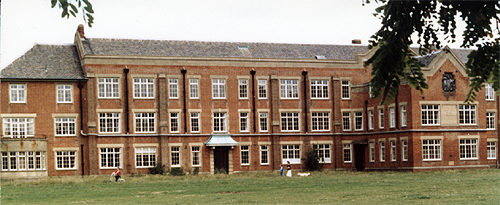
Kipling
Memorial Building (south face) from the lawn
(1)
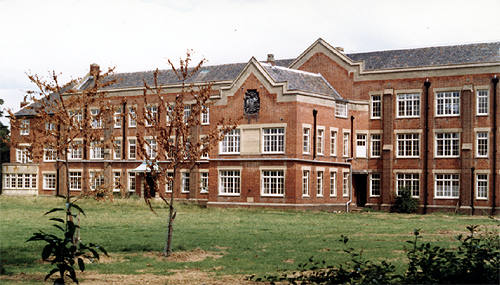 Kipling Memorial
Building (south face) from the lawn (2)
Kipling Memorial
Building (south face) from the lawn (2)
Note the Rudyard Kipling Plaque in the centre of the
building and reproduced below.
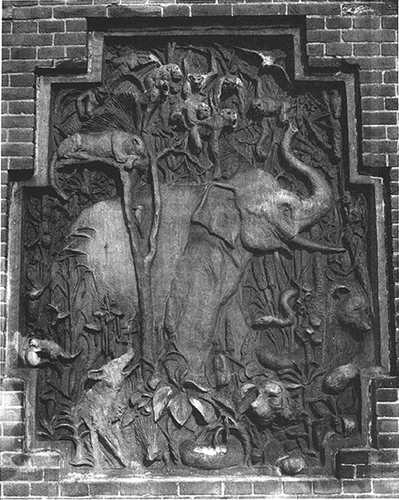
The Rudyard
Kipling Memorial Plaque on the south side of
Kipling Building, overlooking the lawn. Cast in
lead, it was modelled by Mr.Benno Elkan.
Headmaster
Rev. L. de O. Tollemache, 1935-1941
Rev. L. de O.
Tollemache was educated at Winchester College and New
College, Oxford. He was appointed headmaster of ISC in
1935 following the death of Mr. Beckwith. We are
indebted to A Bowra who writes:
I was reading an
old book today and there was an 'interesting' fact
concerning Christian names handed out by parents to
their offspring. In this case it seems the Revd
Ralph William Lyonel Tollemache, 1826-1895, of South
Witham, Lincoln bore seven daughters and seven sons.
Obviously a student of old English history he named
his seventh son, (b. 11 January 1892) as follows:
Lyonulph
Cospatrick Bruce Berkeley Jermyn Tullibardine
Petersham de Orellane Dysart Plantagenet Tollemache.
The birth certificate might make interesting
reading.
Lyunulph
Cospatrick Bruce Berkeley Jermyn Tullibardine
Petersham de Orellana Dysart Plantagenet died on 30
November 1960.
1940
Wartime ISC
The following was published in the
April 1940 issue of the ISC Old Boys' Journal. Whilst
not all is relevant to Windsor, we have included the
extended text as ISC had such close ties with the
British Armed Forces. The school almost certainly lost
in action a much higher percentage of their Old Boys
than other schools.
Time moves
against Germany in all spheres and the past six
months have been of immense value to the Allies in
strengthening their positions. But they cannot win
the war without first destroying the enemy's power
and will to fight and we should be foolish to
underrate his strength. The overthrow of the enemy
can be achieved only by the supreme effort on the
part of every individual directed into the right
channel and this will inevitably entail great
sacrifice. We cannot foretell what lies ahead, but
this year will surely see us put to the test and
the full issue joined. Lord Halifax has said that
we are opposed to an active force of evil that, if
it should triumph, would not permit our
civilization to live. No price, then, is too great
to pay for our freedom.
* * *
The war has
changed the lives and prospects of most of us and
not the least of the difficulties it has created
is the problem facing the boy about to leave his
Public School. If he is destined for the Services
he finds the Cadet Colleges closed to him and if
he contemplated a University degree he will be
able to take only a somewhat truncated course of
study - at any rate for the time being. As the
Headmaster said in his speech on Founders' Day, it
would seem advisable for the undergraduate to
postpone his military training until after he has
taken his degree, but the problem of the boy who
contemplates the Army or Air Force as a career
seems as yet unanswered, and training for a
professional or business career will have to be
viewed in the light of the requirements of militia
training. When peace comes again it is hoped that
the State will tackle such problems without
prejudice and with practical sympathy.
The future of
the Public School system itself may well create a
serious post-war problem, both for parents and
governors. The cost of even the average-priced
Public School has been of late years an increasing
strain on the resources of many parents who are
now faced with possibly dwindling incomes and
certainly increased taxation. Will the State be
compelled to step in and assist the Schools to
lower their fees ? If so, undoubtedly the State
will demand its price. Let us hope it will be a
fair one with due regard for the benefits that,
despite its many shortcomings, the Public School
system has bestowed on the community in the past.
* * *
At the Coll. the
most important development during the year has
been the completion of the Rudyard Kipling
Memorial Block on the old Big Side. The buildings
were designed by Mr. Clyde Young, in collaboration
with Mr. Bernard Engel, and a description of the
building programme was given in last year's
Journal. It had been hoped that there would have
been a formal opening by an important personage,
but the war prevented this. Instead, they were
informally occupied at the beginning of the
Christmas term by the former inhabitants of
Connaught and Roberts Houses. The design is in
harmony with the K.E.H. Hall, the Classrooms and
the proposed Laboratories. In the centre gable of
the south front is a plaque, modelled in cast lead
by Mr. Benno Elkan, illustrating the characters of
The Jungle Book.
A bust of
Rudyard Kipling, which will be placed in the
buildings, has been presented to the Coll. by
H.R.H. Princess Alice and Lord Athlone. The bust
was executed by Madame Ginette Bingguely Lejeune,
and has been on view both in the Royal Academy
Exhibition in London and in the Paris Salon.
Mrs. Kipling
herself died on the 19th December last.
* * *
It is with great
regret that we publish a list, of casualties
suffered already among the ranks of Old Boys of
the Coll. No words of ours are needed to convey
honour to their services or sympathy with the
bereaved.
It is necessary,
however, to point out the requirements of the
Press and Censorship Bureau, set out in a circular
letter to the Headmaster. In the publication of
lists of Old Boys who are serving their country or
who have lost their lives in such service, the
Authorities are anxious that, though the name,
rank and regiment may be given, no reference
should be made to any ship, battalion or other
unit within the regiment, or to any command,
unless such particulars have already been
officially published. It is also requested that no
information should be published that would reveal
the locality in which any member of the Forces is
serving.
* * *
It was reported that 481 Old Boys,
one Assistant Master and three members of the College
staff fell in the Second World War.
It is beyond the scope of this
article to publish the lists of those from ISC who
were killed in action, or serving in the Armed Forces
or who were decorated, but we will retain the
published lists here for as long as is practicable if
anyone would like to research their forebears. Please
contact Thamesweb
ISC
Leaves Windsor
In 1942, just three years after
Kipling Building had been completed, ISC merged with
Haileybury School and moved to Hertford. This was not
as it might seem at first sight a totally unconnected
move, for United Services College at Westwood Ho! was
created by Mr Cormell Price, its first headmaster,
when he took a class to Devon from Haileybury and so,
after over sixty years, the school was, in a sense,
returning to its original roots.
At the time it was hoped or assumed by
many that the move to Hertford was quite possibly a
temporary war-time measure. The following editorial
and letters, as published in the ISC Old Boys Journal
of April 1942, reveal the real background to the move.
 "The Past at
least is secure." Daniel Webster
"The Past at
least is secure." Daniel Webster
We have the sad
duty of confirming the information, which has
already appeared in the Press and has also been
circulated to members, that the I.S.C. will have
come to the end of its existence at Windsor on March
31st, 1942. As from the beginning of the summer term
the Coll. will be amalgamated with Haileybury, under
the title of 'Haileybury and Imperial Service
College'.
The causes which have led the Governors
to make this decision are financial. We understand
that the state of affairs had become so serious that
only a large sum of money could save the situation
and as this was not forthcoming the only alternative
to closing down was to seek an amalgamation.
The Junior School remains at Clewer,
though losing some part of its grounds. Boys from
this will have certain advantages, including some
closed scholarships at Haileybury and I.S.C. The
Trust Funds remain intact and the income will be
used for this purpose, and also for the provision of
Scholarships and Bursaries as before. All the school
buildings including the land known as Big Side are
to be sold, and also the rest of the playing fields,
in order to pay off the indebtedness. The sale of
the former is, however, probably postponed as the
Government has requisitioned the buildings.
It is not for us to apportion the blame
for allowing the finances of the Coll. to have
reached such a deplorable condition, but we have no
hesitation in stating that those responsible should
have realised the situation and should have taken
steps in time to avert the disaster. Those who were
present at the Coming of Age Dinner in 1933 may
perhaps remember the late Mr. Beckwith's words of
warning and those of us who were privileged to
assist him in building up the traditions of the
I.S.C., whether as Masters or as Boys, will deeply
sympathise with Mrs. Beckwith and her family in
seeing his life's work brought to nought.
The Captain of School, as Editor of the
I.S.C. Chronicle, has dealt very ably and
sympathetically with the situation as it affects the
present generation of boys and we are glad to
reprint his editorial below, together with a letter
from Mr. Sidney Beckwith to Ex-Juniors. We would
also call attention to letters from Col. Tapp and
Gen. Godley in the O.U.S.C. Section. [Reproduced below, Ed.]
The closing of the Coll. at Windsor is
naturally as much of a blow to Old as to Present
Boys. The Coll. has a record of which it may justly
be proud. Its members are now scattered over the
face of the earth, fighting the Empire's battles,
and as in the Great War many of the best have
already fallen. Old Boys may be assured that the
best traditions have been maintained to the end, and
we know from observation how manfully and tactfully
the Present have carried on during the very
difficult period of the last two terms. There has
been no rot from within.
The Headmaster of Haileybury, Canon
Bonhote, has given assurances that I.S.C. Boys will
he welcomed and not treated as strangers, and the
hand of friendship has been offered by the President
and Secretary of the Old Haileyburian Society.. The
boys, some one hundred and ten, who are going on
will be housed in Lawrence and Kipling Houses. The
former is already a Haileybury name and we are glad
to note that Maj. Nicholls has been invited to be
its Housemaster. Several other Masters have been
invited to continue their work at Haileybury and
I.S.C. We can only hope that the union will be a
happy one and that the members of each School will
strive to that end by being prepared to accept what
is best in the other.
From all quarters Old Boys have
expressed the hope that, after the war, it may be
possible for the School to return to Windsor.
Financial support on a considerable scale would, of
course, be necessary, but, given the right spirit
and the determination to fight an uphill battle, the
difficulties might not prove unsurmountable. Any
practical suggestions from Old Boys will be
welcomed.
* *
*
The following
editorial and letter are reprinted from the last
number of the I.S.C. Chronicle:-
"The chief
characteristic of the boys of this School is the
nobility of their conception of the purpose of
mankind." So says the Dean of Windsor. And although
this term is to be our last at Windsor, this is an
ideal which we should carry away with us, wherever
we go, ever striving to maintain it throughout all
our lives,
It is hard for us, who have a tradition
peculiar to ourselves to be forced to stand by and
watch our school gradually drifting apart; hut we
must remember that the spirit of a school, and of
this School particularly, is intimately bound up
with the boys themselves. One of the traditions of
the I.S.C. has been that the School has been run by
the boys, and for the boys with the minimum of
needless interference by the masters. Thus it will
be more difficult for us to adapt ourselves to the
routine of another school; but we must never lose
sight of the fact that Haileybury will be
experiencing a similar problem; and although our's
must, of necessity be the greater sacrifice, we must
try and " see the other fellow's point of view," and
not abandon ourselves to fruitless recrimination.
With our recent sporting victories over Haileybury
still fresh in our minds, we know that we shall be
accepted as equals.
We have met Canon Bonhote, and we have
every reason to believe that the social life of this
school is as vital to him as that of Haileybury
itself. We must hear in mind that this amalgamation
will be the ultimate test of the value of the
College, requiring all the strength of our
traditions of Service and Obedience. We must see to
it that we do not try to evade this final duty.
Now, all that remains for us to do, is
to wish all members of this School who are going on
to Hertford the best of good fortune; and we beg
that they will try and remember that they were once
proud to be boys of the Imperial Service College.
By Sydney Beckwith.
(Headmaster at the Junior School)
Dear Ex Juniors,
As this is
probably the last opportunity I shall have of
addressing you through the medium of these notes,
there are one or two things I should like to say to
you.
I have been intimately associated with
the College since 1912, when it first became known
as the Imperial Service College. It was then a small
school of not much more than fifty boys and burdened
with an almost, overwhelming debt. In spite of this,
the School and I grew up together, so to speak,
until its numbers reached nearly four hundred, which
was the goal that had been set for it. Devoted
though my father was to my sister and myself, he
made no secret of the fact that the College was to
him both son and daughter.
You can understand then that the sudden
news that the I.S.C was to be amalgamated with
Haileybury, that the old associations with Windsor
were to be ended, and that most of the land,
redolent of happy memories, was to be delivered into
the hands of the builder, came as a bitter blow to
my family and myself.
You may possibly wonder why the Junior
School is able to continue. The answer is that it
has so far succeeded in paying its way. Whether it
will continue to do so in the future depends largely
on circumstances. The fact that it has in the past
contributed considerably to the upkeep of the
College is perhaps beside the point.
I fully realise what this amalgamation
means to you. It is not only buildings that you will
be leaving behind you. I can only pass on to you a
piece of advice repeatedly given to me by my father
and one which has stood me in, good stead on more
than one occasion: "When the milk has been spilt, go
to the next brown cow." One of the arts of life is
that of knowing how to deal with the fait
accompli.
I am no prophet, but it is by no means
unlikely that by your amalgamation with Haileybury
you are setting an example that will have to be
followed willy-nilly by most of the Public Schools
in the near future. You are at any rate amalgamating
with another Public School of considerable standing,
with a fine reputation both for work and games (yes,
I put them in that order on purpose), and you are
retaining your name.
Just to start with, you may find things
a bit difficult. Schools are usually notoriously
jealous of their customs (often erroneously confused
with traditions) and there may be a tendency at
first for each school to try and show the other
"where they get off." Forget it. Show one another
how to get on. Remember that Haileyburians may not
be much keener on the amalgamation than you are. Be
broadminded. There are two sides to every question.
If the truth will out, probably each school can
learn something of the other. You will find that
masters are much the same whether you call them
beaks, brushers or just tramps, and there is
precious little difference between a prefect and a
monitor. Anyway, we shall all have to adapt
ourselves to circumstances before long, if we have
not done so already.
Three things have always struck me with
regard to the I.S.C.: your splendid good-fellowship,
your outstanding "guts," and your motto, magnificent
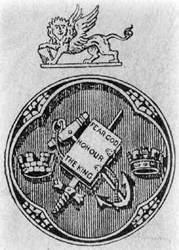
alike in its sentiment and its simplicity, " Fear
God, Honour the King."|
If I were asked to define the tradition
of the I.S.C., a tradition that, in spite of the
comparatively short history of the School, has left
its mark in every corner of the Empire, I should
answer without any hesitation, "The tradition of
turning out men."
So I wish you all the best of luck. We
shall greatly miss you. Take with you to Haileybury
all that was best of the old "Coll," and "quit
yourselves like men," so that whether I.S.C. or
Haileybury and I.S.C. you may still be-
Sons of Empire
Strong to hew
Steps to fame
The wide world through.
Yours
always, SIDNEY B.
It was with great
regret that we learned during the summer holidays
that the Headmaster, Mr. L. de 0. Tollemache, had
decided to resign and take up a Government
appointment under the Midland Regional Commissioner
immediately.
Mr. Tollemache was appointed Headmaster
in April, 1935, after the death of Mr. Beckwith, and
it was evident at once that he did not intend to
work with a "new broom." He recognized and
determined to retain all that was best in the
institutions of the I.S.C.
One of his chief efforts was directed
towards the closer union of the U.S.C. and I.S.C.
and to him is due the credit for the first idea of
the Kipling Memorial Building.
During the period of Mr. Tollemache's
Headmastership numbers reached their high-water mark
and it was after the outbreak of war that the
decline set in which accentuated the financial
difficulties. Far reaching changes were made in the
administration and it came as no surprise when Mr.
Tollemache announced his resignation.
We wish both Mr. and Mrs. Tollemache all
possible happiness in the future.
* *
*
The Journal also
included a summary of the changes that the school had
seen since 1908 following the amalgamation with USC.
1908-1942
From 1908 to 1942
is a far cry, and very many changes have taken place
during that time at the dear old Coll. New buildings
have appeared one by one, and the old Houses have
been altered, in many cases, almost out of
recognition.
The Squash Court is adjoining "D" House
(then "Old House") were taken down before Mr.
Beckwith joined in 1912, as also the Laundry and
Printing Shop, where the "D" House Changing Rooms
now are.
The Dining Hall, which used to be in "A"
House, was transferred to the Rig Hall, which in
early days was used as Classrooms, underneath being
the Gymnasium where the Kitchen now reigns in all
its glory.
The name of the College was altered on
Mr. Beckwith's arrival in 1912, and with his advent
a new regime started. One of the first changes he
made was that of the boys' headgear; caps and
bowlers on Sundays were altered to straw hats (or
Bashers as they are generally called) on weekdays
and Sundays. This change did not appeal to many at
first, but I am sure no boy would be willing to
exchange his Basher for a cap nowadays.
The custom of wearing First and Second
XV caps outside the College was discontinued, much
to the sorrow of the Windsor people, who greatly
enjoyed seeing the boys thus arrayed walking up
Peascod Street on half-holidays.
From 1912 until 1918, when Mr. Oliver
joined, Mr. Beckwith and myself carried on the work
of the School Office alone, and I remember once when
we had to close down three weeks before the end of
the term owing to a bad epidemic of measles, finding
Mr. Beckwith on. my return from London (where I had
been to see a boy off to Scotland) giving out
journey money from my cash box; later on I found my
balance in hand was £10 more than it should have
been and as Mr. Beckwith was sure this sum did not
belong to himself, it was handed over to the School
Mission.
A lot of Canadians, who were stationed
somewhere in the Great Park, [See Smiths
Lawn in our Great
Park article here] were a
great help to the College about the commencement
of 1915, coming over every day and fixing up small
wooden huts on the spare patch between Camperdown
and Alexander Houses. These huts were very much
appreciated as classrooms, and eased the
congestion considerably in the various Houses, but
were found to be very hot in summer and too cold
in winter. During the wet periods a series of
lakes appeared, which had to be waded through,
much to the discomfort of the individual. These
huts were discontinued when the new Classroom
Block was presented by Mr. Macaskie, and what a
red letter day that was too. I remember after the
Foundation Stone had been laid, Mr. Macaskie gave
the Headmaster £50 to be divided amongst the boys;
the boys, after a series of mathematical problems,
found it would mean very little if portioned out
separately and they asked for a dinner to be
provided and everyone attended it in state!
Very many of our Masters joined up,
and were replaced by others; one especially
remains in my memory, probably because his room
was next to my Office in Lawrence House. He was a
very nervous man and, of course, this was soon
spotted by the boys, who used periodically to
creep along the passage and then at a given signal
burst large paper bags. Another Master had a great
dislike of whistling; one Sunday morning a great-
noise was heard outside his study window where a
large number of boys had gathered and were
enjoying themselves thoroughly.
The recent happenings, and all the
very happy times we spent together during Mr.
Tollemache's Headmastership, are too vivid to have
escaped one's memory; and we felt that with his
departure a new era had started, but it was a
tremendous blow to all of us when we heard that
this term would be the last for all of us at
Windsor, and now we find ourselves shortly to be
scattered all over the universe and the dear old
Coll. will be no more; but I am sure that those of
us who have been privileged to be counted amongst
its members and have learned to love every stick
and stone, will always remember the very many
happy times we have spent together, and those boys
who are starting out on life's big adventure, will
never bring discredit on their School Tie and Old
College traditions.
" Fear God.
Honour the King."
Miss
V H Schofield
Also in the Journal of 1942 are
reproduced some of the letters explaining the
situation. The following is taken from the United
Services College Old Boys Society newsletter, by this
time incorporated into the ISC Old Boys Journal. The
correspondence is introduced by Col. G C Hodgson, DSO
of East Molesey, Honorary Secretary of the OUSC
Society,
News
Sheet
OWING to the war
and my still having more than a full-time job with
the Home Guard, I am afraid the heading is a
misnomer, for I have had no spare time to collect
news and O.U.S.Cs. have evidently not had time
either to write and give me any.
Most of the little there is has been
given me by Mr. Hughes, the Hon. Secretary of the
I.S.C.O.B. Society, to whom we are again very much
indebted for his ever ready help and for again most
kindly offering to send to our members the combined
publication.
You will all be very sorry to hear the
tragic news that, owing to financial difficulties
and falling off in numbers, the I.S.C. is closing
down as a separate entity.
The following copies of letters from
Col. H. A. Tapp, a member of our Committee, which I
sent to our Chairman, Gen. Sir A. J. Godley, and
asking him if he could do anything for the return of
the I.S.C. to Windsor after the war, as Tapp
suggests, and his reply will explain the situation
better than any other way, I think:
The first letter is to Col. G C
Hodgson, from Col. H A Tapp.
CRANMORE
LANE,
ALDERSHOT.
14th
February, 1942.
DEAR HODGSON
1. Recently in the
Press it was announced that the Imperial Service
College would shortly leave Windsor and amalgamate
with Haileybury, both Colleges retaining their
identity. It is extremely unlikely that two schools
can really retain their separate identity for long
under such circumstances.
2. Lord
Kenilworth's notice to parents implied that
financial difficulties due to war conditions was the
reason for this 'merger.' To all those interested in
the I.S.C. and its association with Kipling and the
old United Services College, this brief explanation
is not entirely satisfactory.
3. If the I.S.C.
has found it hard to keep going during the last few
years, a thorough overhaul of its administration
could, no doubt, have detected weak spots and
enabled economies to be effected. Other means might
have been found for obtaining the necessary
financial aid.
4. Is the
Governing Council entirely blameless for the present
state of affairs, and has the possibility of
carrying on the I.S.C. at Windsor been sufficiently
examined?
Unfortunately no
desire has been expressed by Lord Kenilworth for the
School's return to Windsor after the war. In fact,
the buildings are up for sale.
5. Quite apart
from the depressed feeling aroused among some of the
Staff, the boys (and after all boys are often good
judges!), and we must include 'old boy' parents, at
the thought of leaving Windsor, there is the aspect
that the Nation's memorial to Rudyard Kipling will
be abandoned. Are these and other memorials to be
lightly discarded?
6. £45,000 has
been collected in recent years for Scholarships and
the building of Kipling memorial houses. A sum of
nearly £30,000 Regimental Funds of the King Edward
Horse provided a very fine School Hall in addition
to Scholarships for the sons of the Regiment. Many
other gifts have been given to the I.S.C. to help
forward the School and to keep alive the memory of
Kipling. Canada and South Africa are particularly
interested in the College. More than ever such an
Institution as the Imperial Service College will
surely be wanted after the war.
7. The surplus
land of the College has been advertised and sold at
a figure which should relieve the College of the
greater part of its financial embarrassment.
8. It is
understood the merging of the I.S.C. with Haileybury
requires the sanction of the Privy Council. Is it
not possible to have the situation re-examined, with
a view to preventing the I.S.C. leaving Windsor or
ensuring its return after the war?
9. I send these
few thoughts to a number of friends who may wish to
start a press campaign to save the I.S.C. - being a
serving soldier I cannot write to the press (thank
goodness!) Action will be needed quickly as time is
pressing.
10. Please forgive
me worrying you, and I only do so in the hopes that
you may agree to put in a plea for maintaining the
I.S.C. at Windsor or for ensuring its return there
after the war.
Yours
sincerely,
H. A. TAPP.
The next letter is also to Col. G C
Hodgson, from General Sir Alexander Godley, GCB, KCMG,
of the Board of Governors of ISC.
THE
ROYAL EMPIRE SOCIETY
NORTHUMBERLAND AVENUE
LONDON, W.C.2.
4th
March, 1942.
MY DEAR COLONEL
As I said I would,
I am writing again to tell you something of what
transpired at Monday's meeting of the Executive
Committee of the I.S.C. I am afraid things have gone
too far for it to be possible in any way to even
postpone the amalgamation with Haileybury. Lord
Kenilworth saw both your letter and Tapp's, and
everything that you both said in them was explained
to the Committee. I feel that I ought to have kept
you better informed of the negotiations for the
amalgamation, but, as I have said to you before, the
circumstances were such that it was necessary to
take immediate action, and we all jumped at the
chance of amalgamation with Haileybury, the school
from which the United Service College originally
came, rather than run any risk of missing the
opportunity by delay; and having to accept some very
much more unsatisfactory solution. It is impossible
in a letter like this to go into the details of the
financial situation, but it was such as to make it
quite impossible to carry on as things were and the
alternative would have been not only bankruptcy but
a most inglorious departure from Windsor. The number
of boys also was dwindling so steadily that there
would not have been enough left with which to carry
on. As it is we march out of Windsor with our flag
flying high, with all our traditions and every
safeguard that the identity of the College will be
in no way lost. The name is to be 'Haileybury and
the Imperial Service College.'
The sale of the
properties will realise such a sum as will enable us
to not only maintain the present boys at their
present fees, but to nominate and bring in other
boys of the same kind under the same conditions and
same circumstances as at Westwood Ho! or at Windsor,
at a fee much lower than the ordinary and which
their parents can afford. Arrangements are being
made for all Memorials worth keeping to be
transferred to Haileybury, or to the Junior School.
Our governors will be well represented on the
Haileybury and I.S.C. Council. They have asked me to
be a Trustee for the disposal of the funds of the
College in the interests of I.S.C. boys and you may
rely upon me to ensure that the Old Boys Societies
are voiced and recognised in every way by the
amalgamated school. I have made a great point of
this in all our discussions and the same applies to
the King Edward Horse, and Kipling, connections.
I am writing to Dunsterville to ask him to become a
Governor, and I hope we may be able to get someone
else of one of the Old Boys' Societies represented
on the Council or Trustees.
The boys were, of
course, very unhappy at first at the idea of leaving
Windsor, but the position has now been thoroughly
explained and I think that they gave come to realise
the situation much better and to be much more
reconciled to it, especially in view of the fact
that they will have many more amenities, as I think
I explained to you before, than they had at Windsor,
and that they are assured that they will be most
sympathetically received. The Headmaster of
Haileybury has already been to Windsor and met the
Prefects, and I believe they were much impressed by
his kindness and evident sympathy with them in their
natural reluctance at the transfer. He is a
particularly nice man, Canon Bonhote, and I am sure
he will do everything to make things easy for them.
If there is
anything more about which you would like
information, or about which I can tell you, do
please write to me again. I can assure you I am only
too anxious to do everything I can to keep the old
School's end up and to satisfy the Old Boys'
Societies in this unfortunate matter. In Tapp's
letter, he is naturally anxious about the Kipling
Memorial Houses and the King Edward Horse, and I can
only repeat that we have every intention, in some
way or other, of identifying both these things with
the amalgamated school.
Yours
sincerely,
ALEX GODLEY
Aftermath
When ISC Senior School moved away
from Windsor, 128 boys and seven masters transferred
to Haileybury School, Hertford. Lawrence House took
over the original Haileybury Lawrence, with Major
Nicholls as House Master and M G R Kingsford as House
Captain. Connaught and Roberts Houses formed Kipling
House and members of Cambridge House joined other
Haileybury houses.
Most of the various memorials from
Windsor were either removed to Haileybury School or
Westwood Ho! before petrol restrictions came into
force. Details appear in the ISC Old Boys Journal of
1943. The Honours Boards from the Dining Hall at
Windsor could not be accommodated at Hertford and so
the names were transcribed onto vellum in book form
and located in the Library at Hertford.
In April 1943 it was reported that
the land at 'Big Side', the Chapel, King Edward Horse
Hall, Kipling Memorial Building, the classrooms,
Dining Hall and 'A', 'B' and 'C' houses were purchased
by Windsor Corporation.
The ISC Junior School became known
as Haileybury and ISC Junior School, and remained at
Clewer Manor, off Imperial Road. The headmaster was
EAS (Sydney) Beckwith, EGA Beckwith's son, a position
he held from 1934-1968.
In April, 1945, three years after
the move, Mr Beckwith wrote the following article for
the Old Boys' Journal.
An Open Letter from Sydney
Beckwith, Headmaster, Junior School
DEAR
O.U.S.C'S. and O.I.S.C.'s.,
It has been
suggested to me by several Old Boys that I should
write a brief account of the Junior School and its
doings in this number of the Old Boys' Journal. I
will, therefore, endeavour to give you all the
necessary information.
No doubt you are by now all aware
of the fact that, since April, 1942, the "Coll." as
a separate entity finally ceased to exist, that it
has permanently amalgamated with Haileybury at
Hertford as Haileybury and Imperial Service College,
that all the land (including a large portion of the
Junior School grounds) has been sold for building
and that Big-Side, including all the buildings, has
been sold to the Town Council for municipal offices,
etc. The idea is, I believe, to make it a civic
centre.
The Junior School, however, now
known as Haileybury and Imperial Service College
Junior School, is still carrying on in its old
surroundings at Clewer Manor. The numbers are just
on 100 and with present accommodation and bookings
there are no more boarding vacancies before 1949. It
is hoped, however, that before then we shall be able
to increase our accommodation. The numbers aimed at
will probably be in the neighbourhood of 100
boarders and possibly 25 day-boys. Unfortunately now
that the surrounding land has been sold the school
will ultimately be situated right in the middle of a
built-up area and there is more than a possibility
that we shall be compelled to move to other premises
in the near neighbourhood. In fact, negotiations
with that end in view are already under way. If we
do have to move no one is likely to regret it more
than myself. I am quite sure, however, that it is
the only policy under the circumstances. Clewer
Manor with its present surroundings is ideal. Clewer
Manor in the middle of a building estate of four
hundred and forty not particularly high-class houses
with Clewer Lodge pulled down and Imperial Road a
by-pass is a different proposition altogether.
Whatever happens, we shall, if possible, remain in
the neighbourhood so as to keep the connection with
Windsor. The present scheme is largely dependent in
the first place on the sanction of the Board of
Education; it is also impossible at the moment to
have any idea as to when we shall be able to build.
In the meantime, a great many boys will have to be
turned away.
At the time of writing, the
following sons of Old Boys' are at the School:
Hetherington, Hazelton and two Webbes. Dark and
Newton i have just left us for the Senior School.
Newton ii is due to join us next term and several
others are entered for as far ahead as 1952. So
don't leave it too late if you want to register your
sons. I have very reluctantly had to refuse several
sons of Old Boys' recently, owing to lack of
accommodation.
Of course the large majority of
boys go on to the Senior School, but we have in
recent times been represented with distinction at
Aldenham, Blundells, Charterhouse, Cheltenham,
Dartmouth, Douai, Eastbourne, Epsom, Merchant
Taylors, Rugby, Pangbourne, the Worcester,
Shrewsbury (£80 scholarship), Merchiston Edinburgh
(Top scholarship) and Wellington (where Holdway was
recently Captain of the School, Captain of
Athletics, Captain of Swimming, and Scrum-half in
the XV).
The XV continues to flourish
(subject to correction I don't think we have lost
more than six school matches during the last ten
years). On the whole we don't have such big scores
as we used to, as we either play stronger schools or
we play an "A" team. At one time we never considered
it a decent win if we scored less than 50 points!
Our two best efforts were 98-0 v. Gayhurst and 79-0
v. Cranleigh Junior School.
The standard of cricket, though
never up to the rugger, is improving and last season
we did not lose a match.
Boxing is taken by Sergt. Major
Featherstone, Instructor at Eton, and judging by the
number of boys who have represented their Public
Schools, afterwards, the standard is good.
The letter goes on
to mention that it is Mr Beckwith's view that the USC
and ISC Old Boys' societies should merge with
Haileybury Old Boys if the newly merged school is
truly to be "Haileybury and ISC". He writes:
"I know very well
that I am treading on very delicate ground, and that
I shall probably bring down a heap of abuse on my
head by what I am going to say. However, I think it
is my duty to do so. I cannot very well be accused
of being pro-Haileybury or anti-ISC and anyway the
Beckwiths have thick skins! I refer to the
amalgamation of the Old Boys' Societies."
This suggestion was not taken kindly
to it seems, or at any rate it had not been acted upon
a year later for in the Journal of 1946 it is reported
that a meeting had taken place in London in March of
that year but that it had been agreed not to progress
the suggestion until after an Annual General Meeting.
In any event, the view was that the two Old Boys'
Societies of United Services and Imperial Service
College should merge first. On 4th June 1946 the AGM
took place and the merging of the two Societies was
unanimously agreed to but that amalgamation with The
Old Haileyburian Society should be left in abeyance.
By the time the 1947 Journal appeared it had been
snappily renamed the Journal of the United Services College
and Imperial Service College Society. Membership was reported to be 700.
In 1966 the junior school became
known simply as Haileybury Junior School and in 1997
amalgamated with Lambrook School in Winkfield, the
land being sold for housing development.
In 1942, the main ISC school
buildings, including Kipling Building, were taken over
by the War Office although it is reported in Windsor
1000 Years [WLHG - out of print] that Windsor
Corporation actually purchased Kipling Building in
1943 for £37,000 so the War Office leased the building
until 1949.
We have been told that Queen Elizabeth II,
when Princess Elizabeth, learnt to drive in the
grounds around Kipling Building at this time. Princess
Elizabeth spent much of her time at Windsor Castle and
Royal Lodge in Windsor Great Park during the war years
with her parents, George VI and Queen Elizabeth, and
her sister Margaret.
Kipling Building was finally taken over by
Windsor Corporation in 1949, using them as the Council
Offices until the merger with Maidenhead Borough in
1974. Berkshire County Council Health Department
occupied the building at the eastern end. Plans in the
early 1950s showed that Kipling Building could have
become a fully fledged 'civic centre' though these
plans never materialised. Instead Borough offices were
built in the form of York House in Sheet Street. A
strange choice of location, being virtually as far
east as it is possible to get in Windsor and not
particularly close to either the main shopping centre
or the majority of the residential areas.
In 1981 Kipling Building was demolished
and replaced by a new building first occupied by Rank
Hovis McDougall, then by Reckitt and Coleman and from
2001 by the Six Continents Hotels group. In 2003 the
site became the offices of the Intercontinental Hotels
group. Here
is a link to more pictures of Kipling Memorial
Building. By coincidence, at the time of the
demolition of Kipling Memorial Building in 1981, the
Chairman of Rank Hovis McDougal, J. McA. Rank, was an
Old Boy of Haileybury Senior School in Hertford.
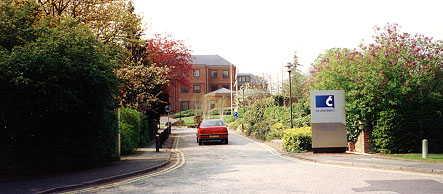
The entrance
to Six Continents Hotels in 2002
originally the entrance to Kipling Building and
lined with flowering crab apples planted in
1949. These were bulldozed away in 1981.
King Edward VII Horse Hall was used
in the 1950s and 60s for public events but was not a
popular venue because of its location. Its demolition
followed to make way for Kipling Court, residential
flats for the elderly. Only the clock from the roof of
The Horse Hall now remains, placed above the main
entrance to Kipling Court in York Road.
The clock from The
Horse Hall
above Kipling Court
During the war, the Macaskie
Classroom Block had also been taken over by the War
Office and used as a barracks. They were finally
demolished to make way for Goslar Way in the mid
1960s.
It is sad to note that the three major
buildings constructed in the 20th century by the
College were demolished after only forty or so years.
Demolition was not an easy task - the buildings were
intended to last for hundreds of years as befitting a
Public School - and it seems that the company charged
with the work significantly underestimated the time it
would take as they were so solidly constructed!
Much of the land sold by ISC in 1942 was
bought by Messrs. Varney, (Builders), who constructed
new residential areas along Springfield Road, Green
Lane, York Road and York Avenue from the 1930s -
1960s.
Vansittart Road Recreation Ground was
threatened with similar building plans in the late
1940s and early 1950s but planning permission was
refused and so Messrs. Varney sold the land to Windsor
Corporation. An attempt to build on the land in 1989
was similarly halted on appeal to the Ministry as
Windsor was, and remains to this day, substantially
short of Public Open Space. Story here
Haileybury Junior School moved
to Winkfield in 1997. In 2001-2002, Clewer
Manor was converted to flats while the surrounding
Open Space has been given over in part to residential
development although a Ministry inspector had refused
an earlier application to develop the site in 1979 "on
the grounds of amenity alone".
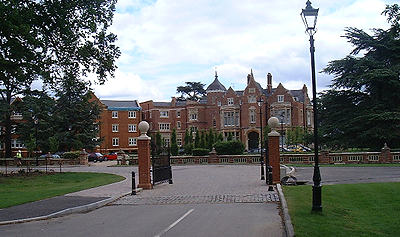
A new
gateway to Clewer Manor, the former Haileybury
Junior School.
The low wall beyond is much older.
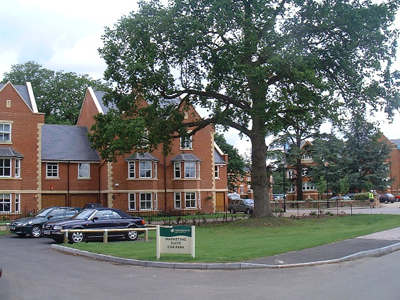 New houses built
around Clewer Manor in 2003
New houses built
around Clewer Manor in 2003
The construction of housing on this
site has necessitated the creation of a wider junction
some 50 yards to the north for the access road to
Imperial Road as well as realignment of the entrance
to Windsor Girls School. This has also provided the
school with additional sports grounds.
Local
Road Names and their link with Imperial Service
College
Several of the roads in this area
reflect the influence and importance to Windsor of the
Imperial Service College and its predecessors from the
1840s. These include St Marks Road and St Marks Place,
Hawtrey Road, Foster Avenue, College Crescent and
Imperial Road which passes alongside Clewer Manor.
Imperial Road was built on the line of the old path
known as 'Lover's Walk', running from St Leonards Road
to Clarence Road, as an unemployment relief scheme in
1923.
Personal
Reminiscences
by former pupil Mike O'Neil-Shaw
17th April 2002
I attended the ISC junior school at
Clewer Manor from February 1940 to December 1946. At
that time the headmaster was Mr Sydney Beckwith, a man
universally liked and respected by both boys and
parents.
I vividly recall the last Sunday service in the senior
school chapel, to which we junior school pupils used
to walk every Sunday. "SB" read the last lesson, but
was overcome with emotion and was unable to finish. I
was only nine years old at the time, but I remember it
as if it had happened yesterday.
After the ISC amalgamated with Haileybury,
I eventually moved on to Haileybury in February 1947.
My six years at Clewer Manor were very happy, with the
emphasis (of course) on sport, especially rugby and
cricket. Looking back on those days, one can see how
idyllic the ambience of the place was, with the
spacious grounds and wooded areas.
As I was there from 1940 to 1946, I well
remember watching the air raids over Windsor from our
dormitory window, with the searchlights, tracer
bullets and explosions of bombs and flak. We had an
unwelcome visitor in the form of an oil bomb, which
fell near one of the rugby pitches, but failed to
explode. Since it fell some distance from the nearest
building, it probably would not have done much damage,
even if it had exploded, but of course it could have
fallen on the buildings just as easily.
When you are eight years of age, you don't
think of death as being in any way relevant. Death is
for adults, usually old ones. It never occurred to us
boys that we were in danger and we treated the thing
as a big firework display.
After the senior school closed, we walked
to the Guards Church [Holy
Trinity Garrison Church, Ed.] in Windsor every
Sunday. The Guards band often played, which we of
course thought was marvellous, and we used to watch
the church parade afterwards, before making the
crocodile walk back to school.
I haven't seen Clewer Manor for over forty
years, as I moved to Australia in 1959, but I can
picture the driveway and the buildings quite clearly.
I hope that whatever is happening to it now will do
justice to the way it used to be.
Mike O'Neil-Shaw
School Colours
Black and gold
House Colours
Cambridge (A): Green and black.
Camperdown (B): Saxe blue and black.
Lawrence (C): Navy blue and silver.
Games Colours (C) North: Maroon,
blue and white. South: Blue and white.
Alexander (D): Blue, black and
white.
Connaught (E): Green, black and
white.
Roberts (F): Red and black.
1st XV. Gold and black stripes
with gold tasseled cap.
1st XI. Blue blazer with school
crest embroidered in re on pocket
Shooting. K E H Colours. (No
reference as to what these might be, though it could
be the colours of the King Edward Horse Regiment)
We
invite other former pupils of ISC to send in their
memories with a picture or two if at all possible.
Other
links
The Blythe family
related to Stephen Hawtrey
Related article - The demolition of the
ISC buildings, Windsor
Haileybury School
Hertford and
Kipling House (One of Haileybury
School's Boarding Houses)
The Kipling Society

To contact us, email
Thamesweb.
|