|
||||||
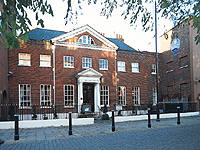 |
Records show that in 1788 the Old House Hotel was owned by the Jervoise family who had taken the house to be close to their son who attended Eton College. Previously the house had been owned by the Cheshire family. During the time of the Cheshire family, the house had been a very lively home full of society and hospitality, until misfortune struck when Mr Cheshire had money and health problems. The eldest daughter married the future Lord Fauconberg who regrettably died soon after from a fit of apoplexy.
Following the Jervoises' ownership, the House was owned by the More family, Mr More being the local bargemaster and coal merchant to the King. More opened a gateway that led to a wharf by the river. He also erected stables for his many horses needed to tow the barges. The More family were able to maintain the house and did not spoil the elegant suite of rooms.
Little information is available on the house in the nineteenth century until 1860 when its ownership seemed to be with a Mr T A More, a possible descendent of the bargemaster and coal merchant.
The brick in the bay of the Drawing Room gives 1752 as the date when the room was possibly extended, and when the fine alabaster fireplace attributed to Sir Thomas Fettiplace, circa 1442, was fitted. The monogram over the Drawing Room door is probably of a family who lived here once.
In the latter part of the nineteenth century, the house was taken by Baroness de Vaux. Her son was much amused by a ghost in one of the bedrooms. His mother would not sleep in that room, and each year some servants left because of the rumours. About 1918, the house was empty for some years. It was known locally as the haunted house, and it was not unusual then for people to go down the steps towards the Donkey House and behind what is now an office block, rather than venture past it. Perhaps it was the false windows over the porch which scared them.
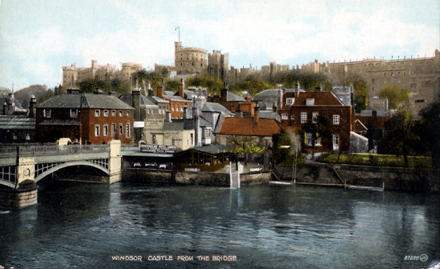
Windsor Bridge and The Old House, centre right, in the 1920s in the days of the Misses Outlaw. Note that the promenade extension and steps to Windsor Bridge were not to be built until the 1930s
In the 1920s two sisters, the Misses Outlaw, ran the House as the Riverholme Restaurant and Guest House. They were very well liked and had great taste. Mr lan Black, an Old Etonian, then bought the house and built the present restaurant. He also extended the building by one floor of bedrooms at the rear of the hotel. From 1946 to 1950, the delightful Potters owned the hotel and they were followed by James Miers. During his earlier years, the hotel thrived and had the enviable reputation as the social centre of the town. He built the second floor of bedrooms at the rear. There was a pretty octagonal house at the very end by the bridge which was a toll house. Unfortunately, this was pulled down. The hotel was then extended by a new wing of bedrooms looking directly over the River Thames and Windsor Bridge.
In 1950, the hotel was registered as a Grade II listed building of historic and architectural interest. The public rooms and bedrooms are furnished with antiques which compliment the character and atmosphere of this fine hotel. The Mogford family took over the hotel from 1982 to 1985, the Mogford brothers being second generation hoteliers. It was then bought by Greenstar Hotels plc who extensively refurbished the hotel.
1996 saw the hotel under new ownership and its services and facilities have been increased by the addition of a Business Centre located within another listed building fronting the river and Windsor Bridge, directly opposite the hotel.